Interrupting the Loop: How Dane County Uses Jail to Manage Crisis

In Dane County, jail is still the only door that never closes in a crisis.
When someone is unhoused, unwell, or struggling with addiction, one bad night can turn into a cell instead of a couch, a clinic, or a bed.
Image by Getty Images
24/7/365: Dane County Jail is always the final remaining, and sometimes the only option available. That is not public safety. It is policy-enforced social management, with a revolving door on the county jail.
So how do we focus on ‘Interrupting the Loop’ and shift the jail from being the county’s most reliable crisis‑response tool to what it was meant to be: a genuine last resort that protects public safety rather than criminalizing social instability and crisis?
Carceral Control as Social Management
Criminal justice reform is often framed around individual components of the system. Some organizations focus on policing, others on sentencing laws, prison conditions, or reentry barriers. Each of these areas matters, but treating them separately can obscure a larger structural problem: the criminal legal system is regularly used as a primary tool for managing social instability. Instead of addressing root causes, the system leans on policing, arrest, detention, supervision, and release as fast responses to homelessness, addiction, untreated mental illness, poverty, and survival-based behavior. To be blatantly clear, this is not a policing issue. This is a policy issue created by those who write the policy.
In practice, that means a county jail starts to function less like a last resort and more like a standing policy for how we handle visible crisis: quietly, quickly, and systemically turning social need into a booking number.
Those responses extend contact with the system and increase instability for individuals, families, and communities. My central focus is carceral control as social management. By this, I mean the use of arrest, detention, bail conditions, probation, parole, and incarceration to contain social problems that could instead be addressed through housing, treatment, income support, and community-based care. In many cases, the system is not reacting to “crime” in any ordinary sense; it is transforming social need into criminal system involvement.
A person who is unhoused may be arrested for trespass. A person with untreated mental illness may be arrested for disorderly conduct. A person using substances to survive trauma may be jailed instead of stabilized. Those responses do not resolve the crisis that produced the behavior. They make the next crisis easier to predict.
Over the last three years, while reviewing local jail booking reports on a near-daily basis, I have watched the same names appear again and again for low-level offenses. One example is Reese, a pseudonym for a woman whose arrests are linked to homelessness, mental illness, and addiction. Her repeated arrests for survival-based conduct says far more about jail being the only open door, than it does about public danger and public safety. Her story is local, but this pattern stretches far beyond Dane County: people in crisis are routed into confinement because community support is unavailable, underfunded, or easier to refuse than custody.
This is what I call the loop: a predictable, self-reinforcing cycle where instability feeds system contact, and system contact feeds more instability.
The Segregation–Punishment Feedback Loop
The most important source of carceral control as social management is a reinforcing relationship between socioeconomic segregation and punitive public response. I refer to this as the Socioeconomic Segregation–Punitive Response Feedback Loop. The loop begins with structural separation: people are sorted by income, race, housing status, education, occupation, disability, and access to public resources. When groups live apart, attend different schools, work in different spaces, and meet public systems under very different conditions, empathy thins out. Social problems become easier to read as personal failure. From that distance, punishment looks reasonable.
Socioeconomic segregation must be addressed because it shapes what people consider dangerous, disorderly, or irresponsible. Segregated social and economic spaces reduce meaningful contact between groups and render homelessness, addiction, untreated mental illness, and poverty distant from “ordinary” life. Political language about the “American Dream,” individual responsibility, and being “tough on crime” often converts structural inequality into a story about personal choices. When instability is consistently framed as individual failure, support for policing, detention, and strict supervision grows.
This is one reason why reforms that focus only on narrow categories of offenses often fall short. Policies limited to “nonserious,” “nonviolent,” or “non-sex-related” offenses may reduce some incarceration but can leave the basic punitive structure intact. The problem is not just what happens inside jails and prisons. It begins with the front-end choice to use the carceral system as the standard response to crisis.
This debate is not about crime and punishment. It is about how we treat people in times of crisis.

This debate is not about crime and punishment. It is about how we treat people in times of crisis.
When you were at your lowest, would Dane County Jail have provided what you needed to get back on your feet?
Jail is not a stepping stone.
Police contact begets police contact.
The Front Door: Where Crisis Becomes a Case
The earliest decisions in the carceral process decide whether a person in crisis is routed toward punishment or toward support. The front door includes initial police contact, booking, the Initial Appearance, pretrial release decisions, charging decisions, and early supervision. Those steps often happen quickly and quietly, garnering little public attention, but they decide whether someone keeps a job, returns home, accesses treatment, or enters another round of detention.
Homelessness, untreated mental illness, addiction, poverty, and survival-based behavior are treated as criminal risk even when the real need is housing, care, and stabilization. The loop is predictable: a lack of resources leads to survival behavior; survival behavior triggers arrest or detention; detention increases instability; and that instability makes future system contact more likely.
At this front door, power sits with several primary actors. District attorneys and prosecutors control charging decisions and coordination with no-charge pathway programs. Judges and court commissioners control release conditions at Initial Appearance. Human services leaders, behavioral health agencies, and budget offices control whether services and placements actually exist for people who would be better served through resources and health services than 3 hots and a cot.
Prosecutors are particularly important because they decide whether survival behavior becomes a criminal case, a forfeiture, a diversion opportunity, or no case at all. A prosecutor can reduce a charge after someone has already lost days in jail, but that does not undo the disruption. Judges and court commissioners are just as central because pretrial conditions can stabilize or destabilize. A presumption of release for low-level, nonviolent matters should be paired with immediate connection to support, not with standard conditions that people focused on survival are unlikely to meet.
Stability Over Sentencing
All behavior is a response to legislation.
The approach I argue for is reparative and stability-focused. It tries to interrupt the loop before the system cements around the person. In concrete terms, that looks like no-charge pathways for low-level survival behavior, presumptions of release, mandatory diversion where detention is not required for safety, 24/7 no-refusal crisis centers, Housing First placements, guaranteed access to treatment, and Stability Coordinators who work as partners in diversion rather than as rule-enforcers waiting to document failure.
These measures do not erase accountability. They make accountability plausible because the person now has a bed, access to care, and a partner helping to remove obstacles. Behavior is a response to legislation and budget choices. When law and funding make jail the only reliably open door, people will keep moving through it.When funding and law require supportive pathways, communities can begin to alter the loop.
Over time, return-on-investment analysis will show that repeated arrest and detention costs more and endangers safety more than crisis response that includes a door, a bed, and support. For that reason, the solution cannot live in a single program. It is a shift from a punishment-first model to a stability-first model.It asks policymakers and the public to stop treating jail as the standard institution for poverty, illness, addiction, and survival. When asylums were forced to close their doors, jails were not meant to be where we rerouted people who were inconvenient.
Stability Over Sentencing is a simple demand dressed in policy detail: make it easier to reach a bed, a doctor, and a Stability Coordinator than it is to reach a jail cell.
Ethics: Human Dignity Is the Baseline
A person should not have to pass through a jail cell to reach a bed, a counselor, medication, detox support, or food. People experiencing homelessness, addiction, untreated mental illness, and poverty are often treated as problems to be moved, booked, or supervised rather than as neighbors whose basic needs are not being met.

This framework is not excusing harmful behavior.
It insists that the response should reduce harm and promote safety, for both the individual and the community, rather than reproduce it.
The main ethical risk is that diversion could appear to favor people accused of crimes over victims or over community safety. The policy has to answer that concern directly. It cannot erase victims’ rights, minimize harm, or push victims into restorative processes they do not want. Stability Over Sentencing should therefore include victim-centered safeguards: notice where appropriate, opt-out rights, informed consent, opportunities for restitution or repair, and clear limits for cases involving serious violence or continuing threats. This concept is not asking anyone to ignore harm. It is asking for responses that make future harm less likely.
Fairness also requires due process. Diversion should not become coercion under a different name. People must retain the right to counsel, the right to understand the charge or alleged violation, the right to refuse a program, and the right to challenge revocation. Stability Coordinators should be navigators, not surveillance officers. Their role is to identify and remove barriers to care and to report what support is needed, not to create another pathway to punishment through technical violations.
The policy is designed to benefit people most harmed by the current system, including unhoused people, people with disabilities, people with mental health or substance use disorders, people living in poverty, and other marginalized communities. A policy that pretends everyone is affected equally will reproduce inequality. We already know this. We’ve seen it in action across society: in schools, workplaces, police profiling, television, movies, music, policy creation, welfare programs, housing, healthcare, banking, lending, environment, sacrifice zones, the list goes on… When we pretend it doesn’t exist, we only further and nurture its ability to create harm. A fair policy has to measure who is arrested, who is detained, who is offered diversion, who is refused services, and who succeeds or fails under supervision, with data broken out by race, gender, disability, housing status, and other key factors.
The ethical test is blunt: does this front door reduce harm, protect rights, and give people closest to the loop real power over a more stable path or are we just renaming punishment and calling it “help?”
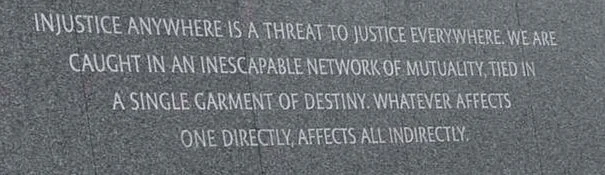
Martin Luther King Jr. Alabama, 1953.